Julkaisut
Tieteellinen lehti:
Finnish Journal of eHealth and eWelfare (FinJeHeW), http://www.finjehew.fi
FinJeHeW on Suomen Telelääketieteen ja eHealth-seuran ja Sosiaali- ja terveydenhuollon tietojenkäsittely-yhdistyksen yhteisesti vuodesta 2009 alkaen julkaisema tieteellinen lehti. Lehti kuuluu julkaisufoorumi-luokkaan 1. Lehden ISSN-tunnus on 1798-0798.
FinJeHeW ottaa vastaan tieteellisiä artikkeleita sekä muuta aineistoa sosiaali- ja terveydenhuollon informaatioteknologiasta, telelääketieteestä ja eHealth-alalta. Kirjoitusohjeet ovat lehden sivustolla. Lehti on pääasiassa suomenkielinen, mutta siinä on artikkeleita, niiden tiivistelmiä ja muuta aineistoa englanniksi. Lehti noudattaa käsikirjoitusten arvioinnissa kahden refereen menettelyä. Lehti ilmestyy ainakin neljä numeroa vuodessa verkkojulkaisuna pdf-muodossa. Lehden kukin numero on vapaasti saatavissa verkosta www.finjehew.fi.
Sosiaali- ja terveydenhuollon sähköisten vastaanottopalveluiden käyttö kaupunki-maaseutu-alueluokituksen mukaan Suomessa fi
The use of electronic health and social care services in urban and rural areas in Finland en
Vehko, Tuulikki; Kyytsönen, Maiju; Ikonen, Jonna; Koskela, Timo; Kainiemi, Emma; Parikka, Suvi
Tiivistelmä
Sähköistä asiointia kohtaan on asetettu terveyspoliittisia tavoitteita harvaan asutuissa länsimaissa. Sosiaali- ja terveydenhuollon palveluita voidaan toteuttaa soveltuvin osin sähköisinä palveluina. Sähköisten palveluiden käyttö edellyttää asiakkailta välineitä sekä osaamista ja tietoa palveluista, joihin hakeutua.
Selvitimme sähköisten sosiaali- ja terveydenhuollon vastaanottopalveluiden käyttöä eri alueilla. Tutkimus perustuu satunnaisesti valittujen 20–99 vuotiaiden henkilöiden antamiin vastauksiin aikuisväestöä edustavassa FinSote 2020 kyselytutkimuksessa (n=28 199, osallistumisaktiivisuus 46 prosenttia). Alueluokituksena käytettiin seitsemänluokkaista kaupunki-maaseutu-alueluokitusta. Tulokset esitetään työikäisille (20–64 vuotiaat) ja eläkeikäisille (65–99 vuotiaat) väestöä edustavina osuuksina vakioimattomina ja demografisten tekijöiden suhteen vakioituna. Sähköisesti vastaanottopalveluita käyttäneiden osuus laskettiin edeltävän vuoden aikana sosiaali- tai terveyspalveluja käyttäneistä. Vastaajan antama arvio siitä, korvasiko sähköinen asiointi vähintään yhden perinteisen soiton tai käynnin, laskettiin sähköisiä sosiaali- ja terveyspalveluja käyttäneistä.
Kaupunkimaisilla alueilla käytettiin useammin sähköisiä vastaanottopalveluja verrattuna maaseutumaisiin alueisiin. Sosiaali- tai terveydenhuollon palveluita käyttäneistä työikäisistä 39 prosenttia oli käyttänyt sähköisiä vastaanottopalveluita sisemmällä kaupunkialueella, kun vastaava osuus harvaan asutulla maaseudulla oli vain 25 prosenttia. Eläkeikäisistä nämä osuudet olivat pienempiä: sisemmällä kaupunkialueella 13 prosenttia ja harvaan asutulla maaseudulla kahdeksan prosenttia. Kun työikäisistä 86 prosenttia ulommalla kaupunkialueella ja 75 prosenttia maaseudun paikalliskeskuksissa raportoi sähköisen asioinnin korvanneen vähintään yhden perinteisen käynnin, niin eläkeikäisillä osuudet olivat pienempiä: 70 prosenttia sisemmällä kaupunkialueella ja 54 prosenttia harvaan asutulla maaseudulla.
Sähköisesti sosiaali- ja terveydenhuollon vastaanottopalveluita käyttäneiden osuus oli melko korkea. Sähköisten vastaanottopalveluiden käyttö oli yleisempää kaupunkialueella kuin harvaan asutulla maaseudulla. Ne, jotka olivat asioineet sosiaali- ja terveydenhuollossa sähköisesti, arvioivat useimmiten, että sähköinen asiointi korvasi perinteisen käynnin. Työikäiset käyttivät sähköistä vastaanottopalvelua useammin kuin ikääntyneet.
Sähköiset palvelut mahdollistavat asioinnin myös harvaan asutuilla seuduilla. Se, miten pitää välineet kaikkien tavoitettavissa, miten voidaan kohentaa osaamista ja tukea sähköisten palveluiden käyttöön ovat haasteita, joihin sosiaali- ja terveyspolitiikan sekä työllisyys- ja koulutuspolitiikan keinoin on vastattava.
Abstract (English)
Several health policy goals have been outlined for electronic services in sparsely populated Western countries. Social and health care services may be implemented as electronic services, where applicable. However, the use of electronic services requires the necessary instruments, skills and service provision.
We investigated the use of electronic services in health care among the adult population in different areas in Finland. The electronic services included contacts with a doctor, registered nurse or social worker by video or by chat. The study is based on responses from randomly selected individuals aged 20 to 99 (n=28 199; participation rate: 46%) at FinSote. The results are presented as non-adjusted and adjusted proportions. We used the seven-class urban–rural classification provided by the Finnish Environment Institute. We report the results for the working-age population (aged 20 to 64) and for the retired population (aged 65 to 99).
In urban areas, the use of electronic services for health or social care was higher than in rural areas. Electronic service use among the working-age population was 39% among those living in inner urban areas compared with 25% of those living in sparsely populated rural areas. The use of electronic services was lower (only 13% and 8% for inner urban areas and sparsely populated rural areas respectively) among those of pensionable age. While 86% of the working-age population in the outer urban area and 75% of those living in local centres in rural areas reported that at least one electronic contact replaced a face-to-face visit, the proportion of those of pensionable age was lower: 70% in the inner urban areas and 54% in sparsely populated rural areas.
Among those members of the population that have used health and social care services within a year, the use of electronic services was relatively high. The use of electronic services was more common in urban areas compared with sparsely populated rural areas. Respondents who had used social and health care services electronically more often stated that the electronic service use replaced the face-to-face visit. The working-aged respondents used electronic services more often than the older respondents.
In the future, more information is needed on the supply of electronic services in the public social and health care services available in different regions. For many, the use of electronic services has become everyday life. How to keep the instruments accessible to everyone, how to improve skills and how to support the use of electronic services are challenges that need to be addressed by both social and health policy and employment and education policy.
Avainsanat
Kanoninen lähde ja PDF: journal.fi. Tätä artikkelia ei ole kopioitu tälle palvelimelle.
Lisenssi: https://creativecommons.org/licenses/by/4.0
Seuran 30-vuotishistoriikki
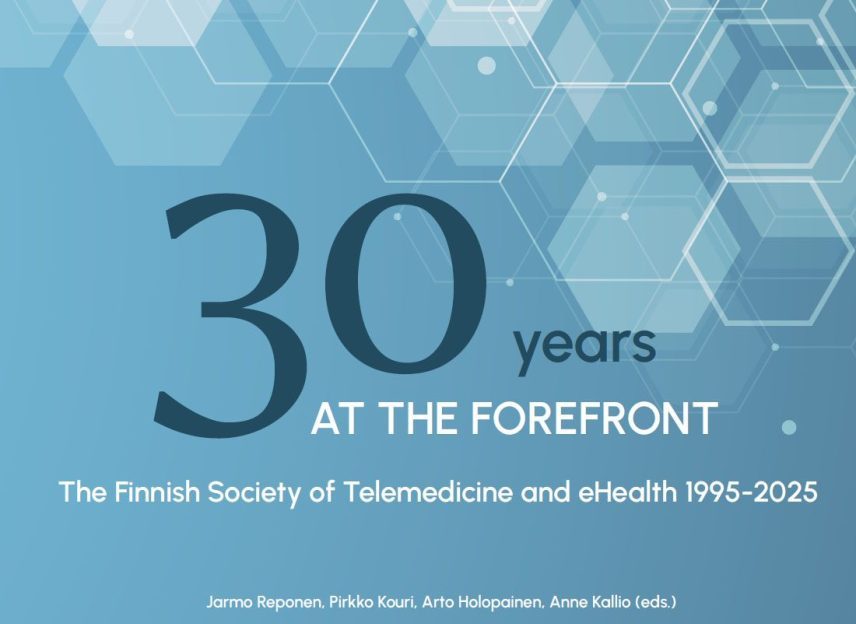
30 VUOTTA KEHITYKSEN KÄRJESSÄ – Suomen telelääketieteen ja e-Health seura 1995-2025, 2025,
ISBN 978-952-65791-1-5 (PDF)
The Society’s 30-Year History
30 Years at the Forefront – The Finnish Society of Telemedicine and eHealth 1995-2025, 2025.
ISBN: 978-952-65791-5-3 (pdf)
Podcastit:
eHealth & Telemedicine Today – by STeHS
What’s happening in digital healthcare right now? In this podcast, STeHS brings you conversations on telemedicine, eHealth, and the evolving healthcare landscape—featuring voices from Finland and beyond.

Innovaatiot ja yrittäjyys suomalaisessa eHealthissa
This episode was recorded live at the eHealth2025 Conference, part of the 30th anniversary of the Finnish Society of Telemedicine and eHealth (STeHS). Hosts of this podcast are Titta Venho and Anna Saranlinna.In this discussion, Kalevi Virta, CEO of eWell Oy, and Arto Holopainen, Innovation Director at the City of Kuopio, share their perspectives on the development of the Finnish eHealth ecosystem, with a particular focus on innovation, entrepreneurship, and collaboration.The conversation explores how digital health has evolved in Finland over the past decades, highlighting key milestones such as mobile technologies, national digital health services, and international collaboration. The speakers reflect on the opportunities and challenges faced by startups and innovators in the health technology sector, including funding, regulation, and access to real-world testing environments.The episode also discusses the role of cities, ecosystems, and collaborative networks in supporting innovation, as well as the importance of early user engagement and cross-sector partnerships. Looking ahead, the discussion touches on future trends such as artificial intelligence, data-driven services, and the increasing demand for sustainable and scalable digital health solutions.Finally, the guests share practical advice for entrepreneurs and emphasize the need for stronger strategic leadership, long-term investment, and continued cooperation between public and private sectors to drive meaningful impact in healthcare.Note: This episode is in Finnish.Full transcript is available in https://www.telemedicine.fi/julkaisut/
Vaikuttavuus digitaalisissa terveyspalveluissa
This episode was recorded live at the eHealth2025 Conference, part of the 30th anniversary of the Finnish Society of Telemedicine and eHealth (STeHS). Hosts of this podcast are Titta Venho and Anna Saranlinna.In this discussion, Mika Perttu, Director of Digital Transformation at the City of Helsinki’s Social, Health and Rescue Division, and Minna Saranpää, Customer Manager and Social and Healthcare Specialist at Vivago Oy, explore the topic of impact and effectiveness in digital health and care services.As digitalisation continues to reshape how healthcare services are delivered, used, and evaluated, the conversation focuses on how to ensure that digital solutions truly create value for patients, professionals, and society. The speakers discuss how effectiveness can be defined, measured, and integrated into service development and decision-making.The episode highlights practical examples from both public and private sectors, addressing challenges such as fragmented systems, limited resources, and the need for better data-driven leadership. It also explores the future role of digital tools, including artificial intelligence and remote care, in improving outcomes and enabling more proactive and personalised healthcare services.Note: This episode is in Finnish.Full transcript is available: https://www.telemedicine.fi/julkaisut/
Women around the world in health care digitalisation
This episode was recorded live at the eHealth2025 Conference, part of the 30th anniversary of the Finnish Society of Telemedicine and eHealth (STeHS). Hosts of this podcast are Titta Venho and Anna Saranlinna.In this discussion, Dr Michelle Griffith, President of ISfTeH, a physician specializing in internal, lifestyle, and integrative medicine with over 30 years of clinical experience, and Professor Pirkko Kouri, Vice President of ISfTeH and a Finnish expert in health informatics and digital health education, explore the theme Women Around the World in Healthcare Digitalisation.Together, they reflect on how gender shapes the development, leadership, and use of digital health services across different cultural and global contexts. The conversation highlights both the challenges women face in technology-driven environments and the critical role they play in designing more inclusive, holistic healthcare solutions.The episode also offers insights into international collaboration, leadership experiences, and practical advice for women aiming to make an impact in the rapidly evolving field of telemedicine and eHealth.Full transcript will be available in: https://www.telemedicine.fi/julkaisut/
Jaksot päivittyvät tälle sivulle automaattisesti. Kaikki jaksot myös Spotifyssa.
Konferenssijulkaisut:
- XXXI Kansallinen ja kansainvälinen Telelääketieteen ja eHealth konferenssi, #eHealth2026: Effective digital solutions in health care and social welfare services, 2026, ISBN 978-952-65791-4-6 (PDF)
- XXX Kansallinen telelääketieteen ja eHealth seminaari, #eHealth2025: Strengthening Interoperability and Equality in Digital Health with Nordic Innovations, 2025, ISBN 978-952-65791-3-9 (PDF)
- XXIX Kansallinen telelääketieteen ja eHealth seminaari, #eHealth2024: From Research to Impact on Digital Health and Welfare Services, 2024, ISBN 978-952-69224-9-2 (PDF)
- XXVIII Kansallinen telelääketieteen ja eHealth seminaari, #eHealth2023: Human oriented approach in eHealth and digital services, 2023, ISBN 978-952-69224-8-5 (pdf)
- XXVII Kansallinen telelääketieteen ja eHealth seminaari, #eHealth2022: Digital Health – from Research to Applied Solutions, 2022, ISBN 978-952-69224-6-1 (PDF)
- XXVI Kansallinen telelääketieteen ja eHealth seminaari, #eHealth2021: eHealth in a Lifecycle, 2021, ISBN: 978-952-69224-4-7 (pdf)
- XXV Kansallinen telelääketieteen ja eHealth seminaari, eHealth2020: From Dream to Reality, 2020, ISBN: 978-952-69224-2-3 (pdf)
- XXIV Kansallinen telelääketieteen ja eHealth seminaari, eHealth2019: Data-Driven Health, 2019, ISBN: 978-952-68112-9-1 (pdf)
- XXIII Kansallinen telelääketieteen ja eHealth seminaari, eHealth2018: Health communities facing cyber transformation, 2018, ISBN: 978-952-68112-8-4 (pdf)
- XXII Kansallinen telelääketieteen ja eHealth seminaari: Win-Win-Win, voittaako kansalainen, ammattilainen ja yhteiskunta?, 2017, ISBN: 978-952-68112-6-0 (pdf)
- XXI Kansallinen telelääketieteen ja eHealth seminaari, Nordic eHealth2016 Kokeilukulttuuri ja digitalisaatio, 2016, ISBN: 978-952-68112-4-6 (pdf)
- XX Kansallinen telelääketieteen ja eHealth seminaari: eHealth, muutoksen moottori, 2015, ISBN: 978-952-68112-2-2 (pdf)
- XIX Kansallinen telelääketieteen ja eHealth seminaari: Matkalla vaikuttavaan eTerveyteen, 2014, ISBN: 978-952-67213-9-2 (pdf)
- XVIII Kansallinen telelääketieteen ja eHealth seminaari: Teknologiatalkoilla parempiin hoitotuloksiin, 2013, ISBN: 978-952-67213-8-5 (pdf)
- XVII Kansallinen telelääketieteen ja eHealth seminaari: Tietoa tarpeeseen, 2012, ISBN: 978-952-67213-6-1 (pdf)
- XVI Kansallinen telelääketieteen ja eHealth seminaari: Maalta maailmalle – Aluemalli terveyspalveluiden kehittämisessä, 2011, ISBN: 978-952-67213-4-7 (pdf)
- XV Kansallinen telelääketieteen ja eHealth seminaari: Katse yli rajojen, 2010, ISBN: 978-952-67213-2-3 (pdf)
- XIV Kansallinen telelääketieteen ja eHealth seminaari: Terveyttä verkosta ja verkostosta, 2009, ISBN: 978-952-67213-0-9 (pdf)
- XIII Kansallinen telelääketieteen ja eHealth seminaari: e-Health kansalaisen palveluksessa, 2008 (pdf)