Publications
Scientific journal:
Finnish Journal of eHealth and eWelfare (FinJeHeW), https://www.finjehew.fi
FinJeHeW is a scientific journal published jointly by the Finnish Society for Telemedicine and eHealth and the Finnish Association for Social and Health Care Informatics since 2009. The journal belongs to publication platform category 1. The ISSN of the journal is 1798-0798.
FinJeHeW welcomes scientific articles and other material related to information technology in social and healthcare services, telemedicine, and eHealth. Author guidelines are available on the journal’s website. The journal is published mainly in Finnish, but it also includes articles, abstracts, and other material in English. Manuscripts are evaluated using a double-referee peer review process. The journal publishes at least four issues per year as an online publication in PDF format. Each issue is freely available online. www.finjehew.fi.
Sosiaali- ja terveydenhuollon tietojärjestelmäkehittäjien kokemuksia yhteistyöstä käyttäjien kanssa fi
Experiences of social and health care information system developers in co-operation with users en
Rytkönen, Jenni; Kinnunen, Ulla-Mari; Martikainen, Susanna
Tiivistelmä
Sosiaali- ja terveydenhuollon päätehtävänä on edistää kansalaisten hyvinvointia ja terveyttä sekä hoitaa sairauksia mahdollisimman hyvin. Tämä tavoitetaan oikea-aikaisilla ja oikeilla päätöksillä, hyvällä hoidolla sekä diagnostiikalla. Tiedonhallintaan tarkoitetuilla asiakas- ja potilastietojärjestelmillä on merkittävä rooli edellä mainittujen päätehtävien toteutumisessa ja toiminnan mahdollistamisessa. Sosiaali- ja terveydenhuollon tietojärjestelmien tulisi tukea ammattilaisten työprosesseja ja työnkulkuja. Alan monimuotoisuuden vuoksi loppukäyttäjien rooli kehitystyössä näyttäytyy eri tavalla, kuin monella muulla alalla. Tietojärjestelmien kehittämistarpeita määriteltäessä tulisi ottaa mukaan laaja sosiaali- ja terveydenhuollon ammattilaisista koostuva käyttäjäkunta. Ammattilaiset ovat halukkaita osallistumaan kehittämiseen mutta he kokevat, ettei loppukäyttäjien kokemuksia oteta huomioon riittävällä tavalla. Asiakas- ja potilastietojärjestelmissä havaitut ongelmat ja teknologian aiheuttamat virheet ovat johtaneet myös potilasturvallisuuden vaarantumiseen.
Tämän tutkimuksen tarkoituksena oli tutkia sosiaali- ja terveydenhuollon tietojärjestelmiä kehittävien ohjelmistokehittäjien kokemuksia ja näkemyksiä käyttäjien osallistumisesta kehittämiseen. Osallistumiseen liittyviä tekijöitä tarkasteltiin ja tunnistettiin sosioteknisen mallin valittujen ulottuvuuksien kautta.
Tutkimus toteutettiin kyselytutkimuksena, jonka tuloksia analysoitiin kvantitatiivisesti. Aineistonkeruu tapahtui sähköisellä kyselylomakkeella, joka toteutettiin suomeksi ja englanniksi ja se välitettiin Valviran tietojärjestelmärekisterissä (päivitetty 9/2019) oleville A-luokan tietojärjestelmätoimittajille. Kyselylomakkeen linkkiä jaettiin myös sosiaalisen median kautta. Aineisto koostuu 87 vastauksesta.
Tutkimustulosten mukaan sosiaali- ja terveydenhuollon tietojärjestelmien kehittäjät haluavat työskennellä aktiivisesti yhteistyössä loppukäyttäjien kanssa ja he kokevat hyötyvänsä käyttäjien antamasta palautteesta. Vakiintuneet menetelmät sekä tarvittavat resurssit yhteistyön mahdollistamiseksi kuitenkin puuttuvat. Kehittäjä- ja käyttäjäorganisaatioiden tuleekin ohjata enemmän resursseja yhteistyön mahdollistamiseksi. Käyttäjiltä saatavan tiedon merkitys kehitystyössä toimii edellytyksenä onnistuneen sosiaali- ja terveydenhuollon tietojärjestelmän kehityksessä.
Abstract (English)
The main task of social welfare and health care is to promote the wellbeing and health of citizens and to treat diseases as well as possible. This is achieved through correct timing and decisions, good care and proper diagnosis. Information systems intended for the management of patient and client information play an important role in the implementation of the above-mentioned main tasks and in enabling activities. Social and health care information systems should support professional work processes and workflows, and the role of end-users in the development of information systems appears differently due to the diversity of the sector than in many other areas. When defining the development needs of information systems, a large group of social and health care professionals should be included. Health care professionals are willing to participate in the development, but they feel that the experiences of end-users are not adequately considered. Problems and technological errors detected in client and patient information systems have also led to a risk to patient safety.
The purpose of this study was to find out the experiences and views of software developers developing social and health care information systems on user participation in the development. Factors related to participation were examined and identified through the selected dimensions of the sociotechnical model.
The study was carried out as a questionnaire, the results of which were analysed quantitatively. The data collection was done with an electronic questionnaire in Finnish and in English and forwarded to the information system suppliers in the Valvira’s (National Supervisory Authority for Welfare and Health in Finland) information system register (updated 9/2019). A link to the questionnaire was also shared on social media. The research material consists of 87 responses.
According to the research findings, software developers developing social and health care information systems want to work actively with end-users and feel that they will benefit from user feedback. However, there is a lack of established methods and the necessary resources to enable cooperation. Developer and user organisations should therefore direct more resources to enable cooperation. The importance of information from users in development work and based on interaction between people and information technology is a prerequisite for the development of a successful social and health care information system.
Avainsanat
Kanoninen lähde ja PDF: journal.fi. Tätä artikkelia ei ole kopioitu tälle palvelimelle.
Lisenssi: http://creativecommons.org/licenses/by-nc-nd/4.0
The society's 30-year history (available only in Finnish)
30 VUOTTA KEHITYKSEN KÄRJESSÄ – Suomen telelääketieteen ja e-Health seura 1995-2025, 2025,
ISBN 978-952-65791-1-5 (PDF)
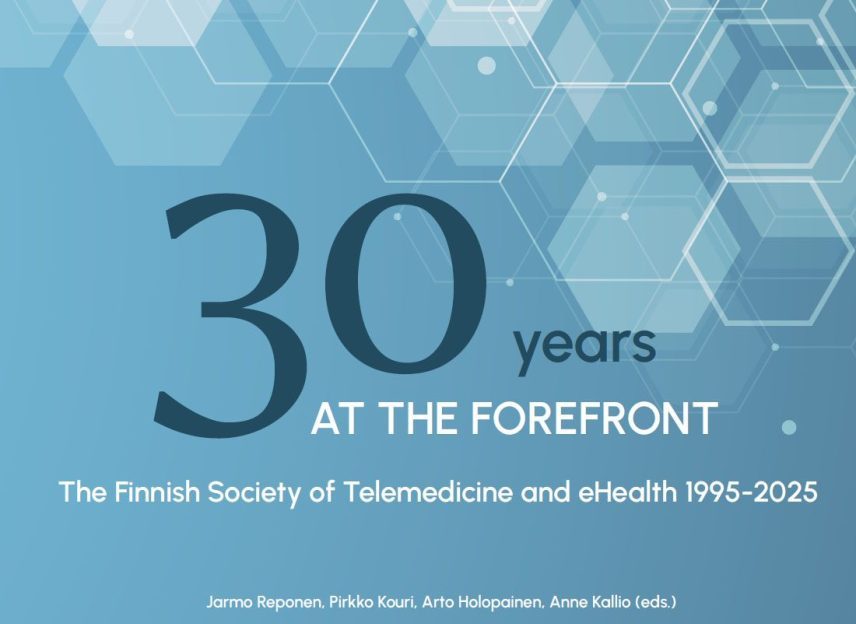
The Society’s 30-Year History
30 Years at the Forefront – The Finnish Society of Telemedicine and eHealth 1995-2025, 2025.
ISBN: 978-952-65791-5-3 (pdf)
Podcasts
eHealth & Telemedicine Today – by STeHS
What’s happening in digital healthcare right now? In this podcast, STeHS brings you conversations on telemedicine, eHealth, and the evolving healthcare landscape—featuring voices from Finland and beyond.

Innovaatiot ja yrittäjyys suomalaisessa eHealthissa
This episode was recorded live at the eHealth2025 Conference, part of the 30th anniversary of the Finnish Society of Telemedicine and eHealth (STeHS). Hosts of this podcast are Titta Venho and Anna Saranlinna.In this discussion, Kalevi Virta, CEO of eWell Oy, and Arto Holopainen, Innovation Director at the City of Kuopio, share their perspectives on the development of the Finnish eHealth ecosystem, with a particular focus on innovation, entrepreneurship, and collaboration.The conversation explores how digital health has evolved in Finland over the past decades, highlighting key milestones such as mobile technologies, national digital health services, and international collaboration. The speakers reflect on the opportunities and challenges faced by startups and innovators in the health technology sector, including funding, regulation, and access to real-world testing environments.The episode also discusses the role of cities, ecosystems, and collaborative networks in supporting innovation, as well as the importance of early user engagement and cross-sector partnerships. Looking ahead, the discussion touches on future trends such as artificial intelligence, data-driven services, and the increasing demand for sustainable and scalable digital health solutions.Finally, the guests share practical advice for entrepreneurs and emphasize the need for stronger strategic leadership, long-term investment, and continued cooperation between public and private sectors to drive meaningful impact in healthcare.Note: This episode is in Finnish.Full transcript is available in https://www.telemedicine.fi/julkaisut/
Vaikuttavuus digitaalisissa terveyspalveluissa
This episode was recorded live at the eHealth2025 Conference, part of the 30th anniversary of the Finnish Society of Telemedicine and eHealth (STeHS). Hosts of this podcast are Titta Venho and Anna Saranlinna.In this discussion, Mika Perttu, Director of Digital Transformation at the City of Helsinki’s Social, Health and Rescue Division, and Minna Saranpää, Customer Manager and Social and Healthcare Specialist at Vivago Oy, explore the topic of impact and effectiveness in digital health and care services.As digitalisation continues to reshape how healthcare services are delivered, used, and evaluated, the conversation focuses on how to ensure that digital solutions truly create value for patients, professionals, and society. The speakers discuss how effectiveness can be defined, measured, and integrated into service development and decision-making.The episode highlights practical examples from both public and private sectors, addressing challenges such as fragmented systems, limited resources, and the need for better data-driven leadership. It also explores the future role of digital tools, including artificial intelligence and remote care, in improving outcomes and enabling more proactive and personalised healthcare services.Note: This episode is in Finnish.Full transcript is available: https://www.telemedicine.fi/julkaisut/
Women around the world in health care digitalisation
This episode was recorded live at the eHealth2025 Conference, part of the 30th anniversary of the Finnish Society of Telemedicine and eHealth (STeHS). Hosts of this podcast are Titta Venho and Anna Saranlinna.In this discussion, Dr Michelle Griffith, President of ISfTeH, a physician specializing in internal, lifestyle, and integrative medicine with over 30 years of clinical experience, and Professor Pirkko Kouri, Vice President of ISfTeH and a Finnish expert in health informatics and digital health education, explore the theme Women Around the World in Healthcare Digitalisation.Together, they reflect on how gender shapes the development, leadership, and use of digital health services across different cultural and global contexts. The conversation highlights both the challenges women face in technology-driven environments and the critical role they play in designing more inclusive, holistic healthcare solutions.The episode also offers insights into international collaboration, leadership experiences, and practical advice for women aiming to make an impact in the rapidly evolving field of telemedicine and eHealth.Full transcript will be available in: https://www.telemedicine.fi/julkaisut/
Jaksot päivittyvät tälle sivulle automaattisesti. Kaikki jaksot myös Spotifyssa.
Conference publications:
- XXXI Kansallinen ja kansainvälinen Telelääketieteen ja eHealth konferenssi, #eHealth2026: Effective digital solutions in health care and social welfare services, 2026, ISBN 978-952-65791-4-6 (PDF)
- XXX Kansallinen telelääketieteen ja eHealth seminaari, #eHealth2025: Strengthening Interoperability and Equality in Digital Health with Nordic Innovations, 2025, ISBN 978-952-65791-3-9 (PDF)
- XXIX National Seminar on Telemedicine and eHealth, #eHealth2024: From Research to Impact on Digital Health and Welfare Services, 2024, ISBN 978-952-69224-9-2 (PDF)
- XXVIII National Telemedicine and eHealth Seminar, #eHealth2023: Human oriented approach in eHealth and digital services, 2023, ISBN 978-952-69224-8-5 (pdf)
- XXVII National Telemedicine and eHealth Seminar, #eHealth2022: Digital Health – from Research to Applied Solutions, 2022, ISBN 978-952-69224-6-1 (PDF)
- XXVI National Telemedicine and eHealth Seminar, #eHealth2021: eHealth in a Lifecycle, 2021, ISBN: 978-952-69224-4-7 (pdf)
- XXV National Telemedicine and eHealth Seminar, eHealth2020: From Dream to Reality, 2020, ISBN: 978-952-69224-2-3 (pdf)
- XXIV National Telemedicine and eHealth Seminar, eHealth2019: Data-Driven Health, 2019, ISBN: 978-952-68112-9-1 (pdf)
- XXII National Telemedicine and eHealth Seminar, eHealth2018: Health communities facing cyber transformation, 2018, ISBN: 978-952-68112-8-4 (pdf)
- XXII National Telemedicine and eHealth Seminar, Win-Win-Win, for citizens, professionals and society, 2017, ISBN: 978-952-68112-6-0 (pdf)
- XXI National Telemedicine and eHealth Seminar, Nordic eHealth2016 Culture of experimentation and digitalisation, 2016, ISBN: 978-952-68112-4-6 (pdf)
- XX National Telemedicine and eHealth Seminar, eHealth, an engine for change, 2015, ISBN: 978-952-68112-2-2 (pdf)
- XIX National Telemedicine and eHealth Seminar, Towards effective eHealth, 2014, ISBN: 978-952-67213-9-2 (pdf)
- XVIII Kansallinen telelääketieteen ja eHealth seminaari: Teknologiatalkoilla parempiin hoitotuloksiin, 2013, ISBN: 978-952-67213-8-5 (pdf)
- XVII Kansallinen telelääketieteen ja eHealth seminaari: Tietoa tarpeeseen, 2012, ISBN: 978-952-67213-6-1 (pdf)
- XVI Kansallinen telelääketieteen ja eHealth seminaari: Maalta maailmalle – Aluemalli terveyspalveluiden kehittämisessä, 2011, ISBN: 978-952-67213-4-7 (pdf)
- XV Kansallinen telelääketieteen ja eHealth seminaari: Katse yli rajojen, 2010, ISBN: 978-952-67213-2-3 (pdf)
- XIV Kansallinen telelääketieteen ja eHealth seminaari: Terveyttä verkosta ja verkostosta, 2009, ISBN: 978-952-67213-0-9 (pdf)
- XIII Kansallinen telelääketieteen ja eHealth seminaari: e-Health kansalaisen palveluksessa, 2008 (pdf)