Publications
Scientific journal:
Finnish Journal of eHealth and eWelfare (FinJeHeW), https://www.finjehew.fi
FinJeHeW is a scientific journal published jointly by the Finnish Society for Telemedicine and eHealth and the Finnish Association for Social and Health Care Informatics since 2009. The journal belongs to publication platform category 1. The ISSN of the journal is 1798-0798.
FinJeHeW welcomes scientific articles and other material related to information technology in social and healthcare services, telemedicine, and eHealth. Author guidelines are available on the journal’s website. The journal is published mainly in Finnish, but it also includes articles, abstracts, and other material in English. Manuscripts are evaluated using a double-referee peer review process. The journal publishes at least four issues per year as an online publication in PDF format. Each issue is freely available online. www.finjehew.fi.
Experiences of Navigator, a Finnish patient-segmentation service, in primary care: A mixed-methods study en
Riihimies, Riikka; Kosunen, Elise; Koskela, Tuomas
Abstract
Aging and multimorbid populations burden health services worldwide. Segmenting patients with similar health service needs into different groups and guiding care providers to tailor services to these groups could reduce this burden. Methods of patient segmentation have been based on, e.g., databases. However, the Finnish patient-segmentation innovation Navigator (Suuntima) considers patients’ perspectives on their coping in everyday life, as well as professionals’ views of the patients’ state of health. The segmentation is based on questions. The resulting care pathway related to the group helps professionals to coordinate patients’ health care and patients to utilize appropriate services.
This first part of Navigator’s validation study evaluates its feasibility and content and face validity. We assess the web-service’s user experiences at nurses’ appointments with diabetic patients, time consumption, and Navigator’s question relevance, comprehensiveness, and comprehensibility.
This mixed-methods study uses user experience questionnaires for both patients and professionals, and semi-structured focus-group interviews for professionals. We used descriptive statistics in the quantitative data analysis of the questionnaire study and thematic analysis to identify the codes and themes in the interview data.
All 304 Navigator queries were completed at appointments. Most patients found Navigator easy to use. It helped in considering their situation better and from new perspectives. Most patients did not find it too time-consuming. Most professionals found it easy to use and suitable for appointments and patient segmentation. The questions were easy and unambiguous, and they assisted in discussing new or sensitive issues. Most queries were completed in less than 19 mins and less time was used if the patient was assigned to the nurse. Thematic analysis raised five main themes: 1) Well-functioning web-service, 2) Stimulus for conversation and action, 3) Rationale to complete Navigator with a professional, 4) Training and experience ease the use of Navigator, and 5) Navigator's room for improvement. Subthemes were identified for three main themes.
We consider Navigator’s feasibility and face validity to be favorable. We suggest user instructions and the clarification of concepts to support the questions’ comprehensibility. Some patients may benefit from a nurse’s presence when responding to Navigator’s questions.
Tiivistelmä (suomi)
Aging and multimorbid populations burden health services worldwide. Segmenting patients with similar health service needs into different groups and guiding care providers to tailor services to these groups could reduce this burden. Methods of patient segmentation have been based on, e.g., databases. However, the Finnish patient-segmentation innovation Navigator (Suuntima) considers patients’ perspectives on their coping in everyday life, as well as professionals’ views of the patients’ state of health. The segmentation is based on questions. The resulting care pathway related to the group helps professionals to coordinate patients’ health care and patients to utilize appropriate services.
This first part of Navigator’s validation study evaluates its feasibility and content and face validity. We assess the web-service’s user experiences at nurses’ appointments with diabetic patients, time consumption, and Navigator’s question relevance, comprehensiveness, and comprehensibility.
This mixed-methods study uses user experience questionnaires for both patients and professionals, and semi-structured focus-group interviews for professionals. We used descriptive statistics in the quantitative data analysis of the questionnaire study and thematic analysis to identify the codes and themes in the interview data.
All 304 Navigator queries were completed at appointments. Most patients found Navigator easy to use. It helped in considering their situation better and from new perspectives. Most patients did not find it too time-consuming. Most professionals found it easy to use and suitable for appointments and patient segmentation. The questions were easy and unambiguous, and they assisted in discussing new or sensitive issues. Most queries were completed in less than 19 mins and less time was used if the patient was assigned to the nurse. Thematic analysis raised five main themes: 1) Well-functioning web-service, 2) Stimulus for conversation and action, 3) Rationale to complete Navigator with a professional, 4) Training and experience ease the use of Navigator, and 5) Navigator's room for improvement. Subthemes were identified for three main themes.
We consider Navigator’s feasibility and face validity to be favorable. We suggest user instructions and the clarification of concepts to support the questions’ comprehensibility. Some patients may benefit from a nurse’s presence when responding to Navigator’s questions.
Avainsanat
Kanoninen lähde ja PDF: journal.fi. Tätä artikkelia ei ole kopioitu tälle palvelimelle.
Lisenssi: http://creativecommons.org/licenses/by-nc-nd/4.0
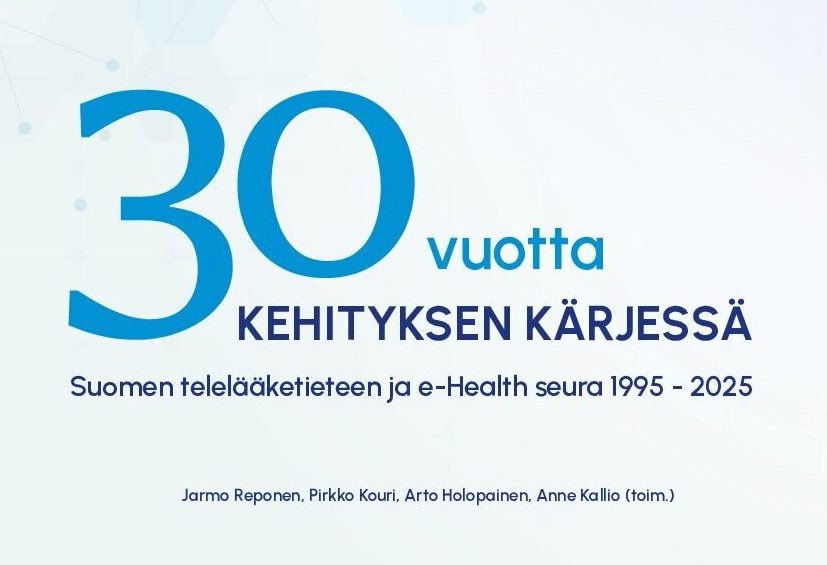
The society's 30-year history (available only in Finnish)
30 VUOTTA KEHITYKSEN KÄRJESSÄ – Suomen telelääketieteen ja e-Health seura 1995-2025, 2025,
ISBN 978-952-65791-1-5 (PDF)
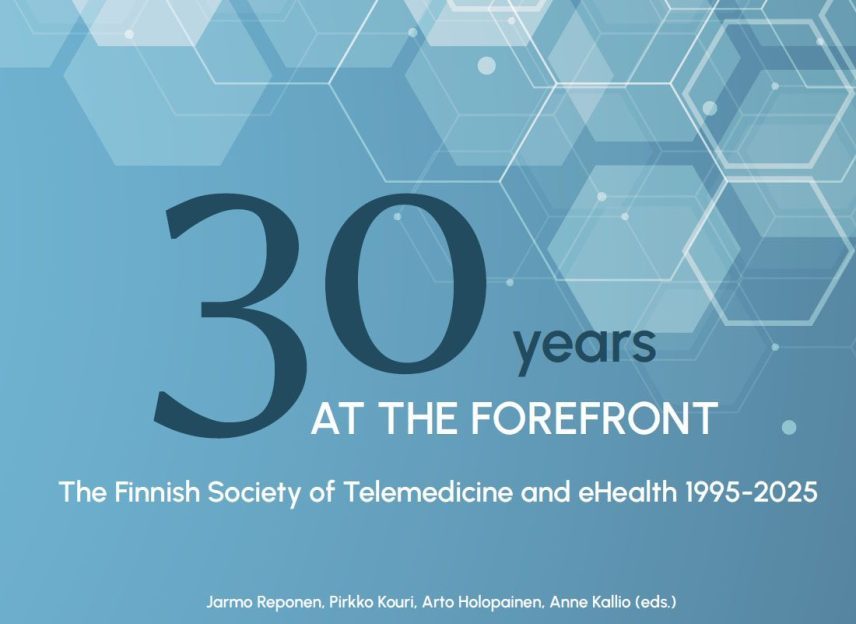
The Society’s 30-Year History
30 Years at the Forefront – The Finnish Society of Telemedicine and eHealth 1995-2025, 2025.
ISBN: 978-952-65791-5-3 (pdf)
Podcasts
eHealth & Telemedicine Today – by STeHS
What’s happening in digital healthcare right now? In this podcast, STeHS brings you conversations on telemedicine, eHealth, and the evolving healthcare landscape—featuring voices from Finland and beyond.

Innovaatiot ja yrittäjyys suomalaisessa eHealthissa
This episode was recorded live at the eHealth2025 Conference, part of the 30th anniversary of the Finnish Society of Telemedicine and eHealth (STeHS). Hosts of this podcast are Titta Venho and Anna Saranlinna.In this discussion, Kalevi Virta, CEO of eWell Oy, and Arto Holopainen, Innovation Director at the City of Kuopio, share their perspectives on the development of the Finnish eHealth ecosystem, with a particular focus on innovation, entrepreneurship, and collaboration.The conversation explores how digital health has evolved in Finland over the past decades, highlighting key milestones such as mobile technologies, national digital health services, and international collaboration. The speakers reflect on the opportunities and challenges faced by startups and innovators in the health technology sector, including funding, regulation, and access to real-world testing environments.The episode also discusses the role of cities, ecosystems, and collaborative networks in supporting innovation, as well as the importance of early user engagement and cross-sector partnerships. Looking ahead, the discussion touches on future trends such as artificial intelligence, data-driven services, and the increasing demand for sustainable and scalable digital health solutions.Finally, the guests share practical advice for entrepreneurs and emphasize the need for stronger strategic leadership, long-term investment, and continued cooperation between public and private sectors to drive meaningful impact in healthcare.Note: This episode is in Finnish.Full transcript is available in https://www.telemedicine.fi/julkaisut/
Vaikuttavuus digitaalisissa terveyspalveluissa
This episode was recorded live at the eHealth2025 Conference, part of the 30th anniversary of the Finnish Society of Telemedicine and eHealth (STeHS). Hosts of this podcast are Titta Venho and Anna Saranlinna.In this discussion, Mika Perttu, Director of Digital Transformation at the City of Helsinki’s Social, Health and Rescue Division, and Minna Saranpää, Customer Manager and Social and Healthcare Specialist at Vivago Oy, explore the topic of impact and effectiveness in digital health and care services.As digitalisation continues to reshape how healthcare services are delivered, used, and evaluated, the conversation focuses on how to ensure that digital solutions truly create value for patients, professionals, and society. The speakers discuss how effectiveness can be defined, measured, and integrated into service development and decision-making.The episode highlights practical examples from both public and private sectors, addressing challenges such as fragmented systems, limited resources, and the need for better data-driven leadership. It also explores the future role of digital tools, including artificial intelligence and remote care, in improving outcomes and enabling more proactive and personalised healthcare services.Note: This episode is in Finnish.Full transcript is available: https://www.telemedicine.fi/julkaisut/
Women around the world in health care digitalisation
This episode was recorded live at the eHealth2025 Conference, part of the 30th anniversary of the Finnish Society of Telemedicine and eHealth (STeHS). Hosts of this podcast are Titta Venho and Anna Saranlinna.In this discussion, Dr Michelle Griffith, President of ISfTeH, a physician specializing in internal, lifestyle, and integrative medicine with over 30 years of clinical experience, and Professor Pirkko Kouri, Vice President of ISfTeH and a Finnish expert in health informatics and digital health education, explore the theme Women Around the World in Healthcare Digitalisation.Together, they reflect on how gender shapes the development, leadership, and use of digital health services across different cultural and global contexts. The conversation highlights both the challenges women face in technology-driven environments and the critical role they play in designing more inclusive, holistic healthcare solutions.The episode also offers insights into international collaboration, leadership experiences, and practical advice for women aiming to make an impact in the rapidly evolving field of telemedicine and eHealth.Full transcript will be available in: https://www.telemedicine.fi/julkaisut/
Jaksot päivittyvät tälle sivulle automaattisesti. Kaikki jaksot myös Spotifyssa.
Conference publications:
- XXXI Kansallinen ja kansainvälinen Telelääketieteen ja eHealth konferenssi, #eHealth2026: Effective digital solutions in health care and social welfare services, 2026, ISBN 978-952-65791-4-6 (PDF)
- XXX Kansallinen telelääketieteen ja eHealth seminaari, #eHealth2025: Strengthening Interoperability and Equality in Digital Health with Nordic Innovations, 2025, ISBN 978-952-65791-3-9 (PDF)
- XXIX National Seminar on Telemedicine and eHealth, #eHealth2024: From Research to Impact on Digital Health and Welfare Services, 2024, ISBN 978-952-69224-9-2 (PDF)
- XXVIII National Telemedicine and eHealth Seminar, #eHealth2023: Human oriented approach in eHealth and digital services, 2023, ISBN 978-952-69224-8-5 (pdf)
- XXVII National Telemedicine and eHealth Seminar, #eHealth2022: Digital Health – from Research to Applied Solutions, 2022, ISBN 978-952-69224-6-1 (PDF)
- XXVI National Telemedicine and eHealth Seminar, #eHealth2021: eHealth in a Lifecycle, 2021, ISBN: 978-952-69224-4-7 (pdf)
- XXV National Telemedicine and eHealth Seminar, eHealth2020: From Dream to Reality, 2020, ISBN: 978-952-69224-2-3 (pdf)
- XXIV National Telemedicine and eHealth Seminar, eHealth2019: Data-Driven Health, 2019, ISBN: 978-952-68112-9-1 (pdf)
- XXII National Telemedicine and eHealth Seminar, eHealth2018: Health communities facing cyber transformation, 2018, ISBN: 978-952-68112-8-4 (pdf)
- XXII National Telemedicine and eHealth Seminar, Win-Win-Win, for citizens, professionals and society, 2017, ISBN: 978-952-68112-6-0 (pdf)
- XXI National Telemedicine and eHealth Seminar, Nordic eHealth2016 Culture of experimentation and digitalisation, 2016, ISBN: 978-952-68112-4-6 (pdf)
- XX National Telemedicine and eHealth Seminar, eHealth, an engine for change, 2015, ISBN: 978-952-68112-2-2 (pdf)
- XIX National Telemedicine and eHealth Seminar, Towards effective eHealth, 2014, ISBN: 978-952-67213-9-2 (pdf)
- XVIII Kansallinen telelääketieteen ja eHealth seminaari: Teknologiatalkoilla parempiin hoitotuloksiin, 2013, ISBN: 978-952-67213-8-5 (pdf)
- XVII Kansallinen telelääketieteen ja eHealth seminaari: Tietoa tarpeeseen, 2012, ISBN: 978-952-67213-6-1 (pdf)
- XVI Kansallinen telelääketieteen ja eHealth seminaari: Maalta maailmalle – Aluemalli terveyspalveluiden kehittämisessä, 2011, ISBN: 978-952-67213-4-7 (pdf)
- XV Kansallinen telelääketieteen ja eHealth seminaari: Katse yli rajojen, 2010, ISBN: 978-952-67213-2-3 (pdf)
- XIV Kansallinen telelääketieteen ja eHealth seminaari: Terveyttä verkosta ja verkostosta, 2009, ISBN: 978-952-67213-0-9 (pdf)
- XIII Kansallinen telelääketieteen ja eHealth seminaari: e-Health kansalaisen palveluksessa, 2008 (pdf)